Rodent management in Northwest Ohio addresses distinct seasonal behaviors dictated by the Lake Erie watershed and urban infrastructure. In historical housing stocks like the Old West End and Five Points, stone rubble…
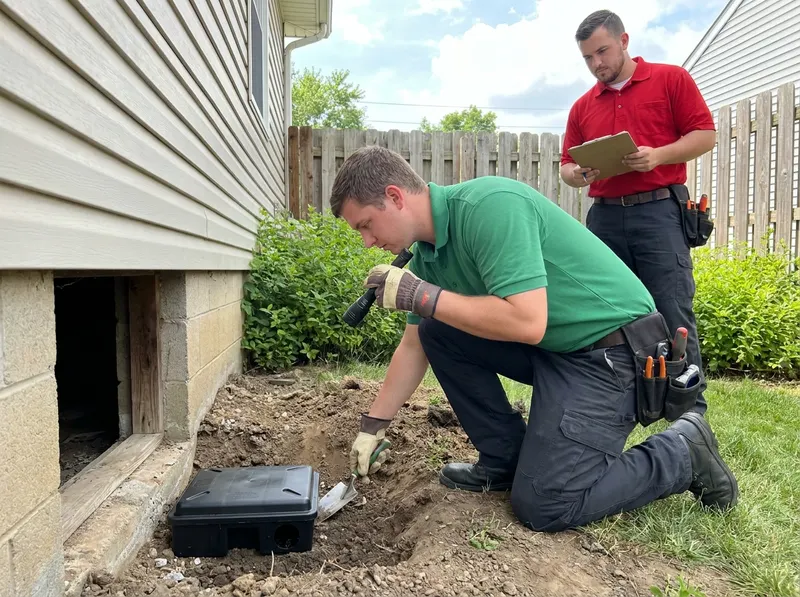
Rodent management in Northwest Ohio addresses distinct seasonal behaviors dictated by the Lake Erie watershed and urban infrastructure. In historical housing stocks like the Old West End and Five Points, stone rubble foundations and settling subfloors present accessible pathways for Mus musculus seeking winter thermal cover. Along the Ottawa River and Maumee River corridors, including Point Place, East Toledo, and Birmingham, Norway rats frequently move upward from high-water table banks and municipal storm easements. Eradication prioritizes structural physics over superficial surface treatments, utilizing 19-gauge galvanized hardware cloth, elastomeric sealants, and metal flashing to close points where foundation sills meet masonry walls.
Selecting a commercial intervention fits properties where domestic hardware-store snap traps fail to address breeding colonies behind wall cavities. A single female house mouse produces up to 10 litters annually, with gestation lasting 19 to 21 days, rendering passive bait stations insufficient for established populations. Professional rodent remediation differs from general perimeter pesticide spraying by avoiding broad-spectrum chemical exposure inside living spaces. Targeted mechanical trapping inside tamper-resistant perimeter stations and interior utility chaseways isolates rodent activity away from domestic zones, protecting household occupants and pets from secondary residue.
1. Initial diagnostic: Technicians map rub marks, droppings, and thermal signatures from utility penetrations to attic ridge lines across properties in Beverly, Reynolds Corners, and West Toledo. 2. Mechanical exclusion: Installers seal exterior gaps larger than 0.25 inches around plumbing stacks, AC linesets, and crawlspace vents. 3. Population elimination: Trapping grids deploy in non-living utility channels to systematically remove the population within 7 to 14 days. 4. Sanitization and monitoring: Contaminated nesting materials undergo targeted extraction, followed by bi-weekly capture logs until zero activity registers.
Every job gets a firm, written price after a free on-site visit.
Tell us about your rodent control job in Toledo and we'll send a clear, written quote, usually the same day.
 Jorvian Pest Management